

How to Compare Corporate Video Quotations in Hong Kong
Compare video quotations using an editable brief, a worked example and a scope sheet covering edits, filming, language versions, review rounds and handover.
- Ask every supplier to price the same written brief and list unresolved assumptions.
- Count distinct edits, video exports and caption files separately.
- Confirm review stages, permitted use and handover before comparing the agreed totals.
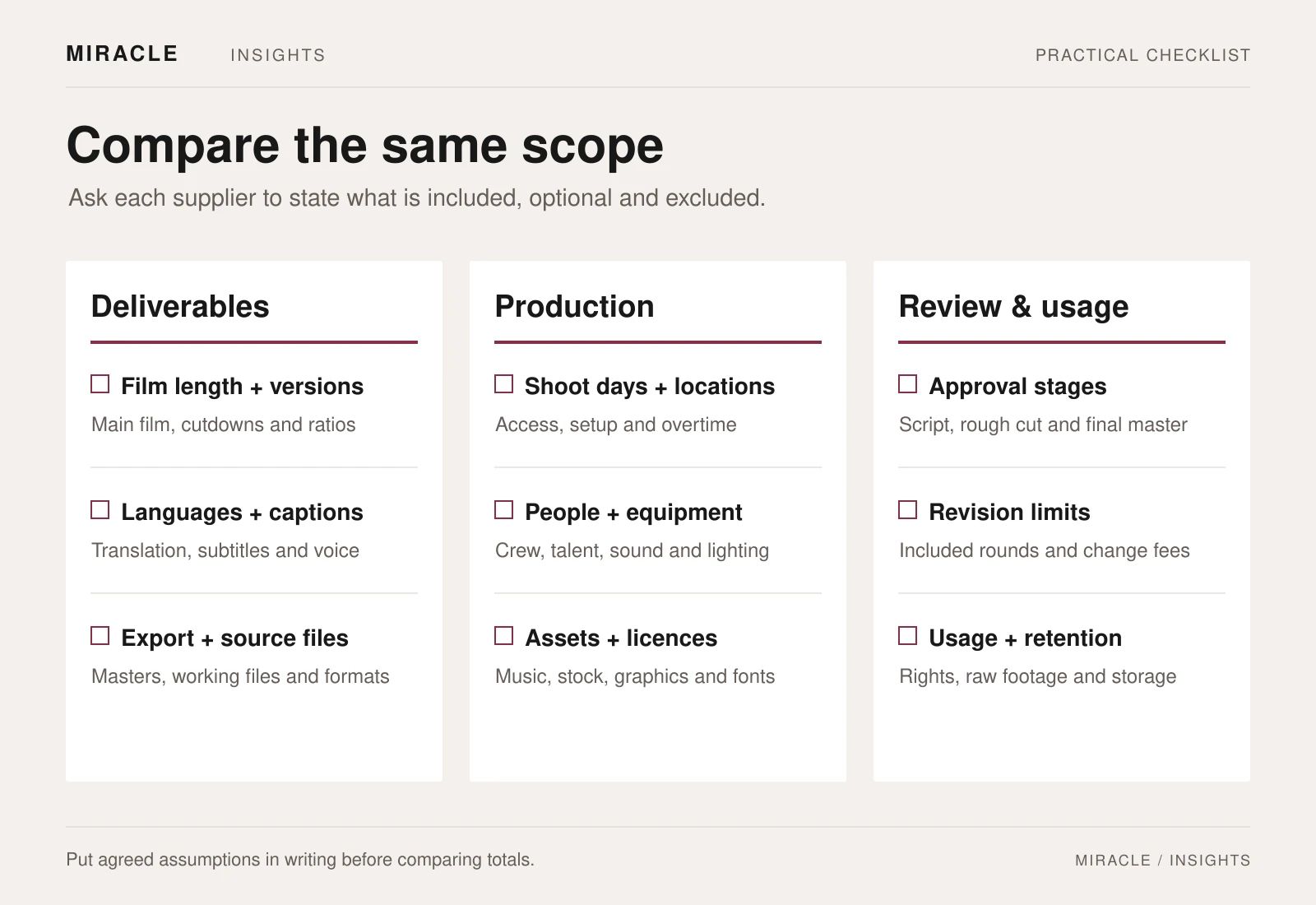
Compare corporate video quotations against one written scope before comparing their totals. List every finished version, filming assumption, approval stage and usage requirement. Ask each supplier to mark the same items as included, optional, excluded or awaiting clarification.
Two proposals can both promise a “corporate video” while covering different work. One may include scripting, interviews and social edits. Another may assume you will supply the script and footage for one finished film.
This guide helps marketing, communications and procurement teams make those differences visible.
Start with the working pack: Download the editable video brief and scope comparison. It contains a blank brief, a clearly labelled hypothetical example and a supplier-comparison sheet.
1. Give every supplier the same starting brief
Before asking for a price, agree:
- Who will watch and what they should understand or do afterwards
- The main message and facts that must be accurate
- Where the film will appear
- Available people, locations, footage and brand assets
- Required versions and delivery constraints
- Budget parameters, reviewers and the final decision-maker
Describe what you like about reference films: interview style, pacing, lighting or graphics. A link alone leaves the supplier to guess which feature matters.
Miracle’s video production service covers creative and production work. In your brief, specify the stages you want the production partner to own and the material your team will supply.
2. Count edits and export versions separately
Write one line for every required output. Include its purpose, approximate duration, aspect ratio, spoken language, on-screen language, captions and file requirements.
Hypothetical brief: A Hong Kong professional-services company needs one 90-second landscape recruitment film and two separate 20-second vertical employee stories. The interviews are in Cantonese. All three edits need a clean export, an English-subtitled export and a separate English caption file.
That is three edits, six video exports and three caption files. It is not simply “one video with social versions”. These quantities illustrate a scope; they are not a production recommendation for every project.
A shorter version may need a different opening and ending. A vertical version may need reframing and repositioned graphics. Ask the supplier to describe the adaptation rather than assume it is a quick crop.
Also distinguish text embedded permanently in the picture from separate timed caption files. YouTube supports several subtitle and caption workflows, so name the files your publishing team needs instead of relying on the word “subtitles”.
3. Check what the filming day actually includes
Compare shoot days, locations, contributors and setup time. Ask how travel, overtime, additional locations and rescheduling would be handled.
For an office shoot, provide practical details:
- Building access, loading and lift arrangements
- Rooms available and the hours they can be occupied
- Background noise and restricted working areas
- Contributors’ availability and approval arrangements
- Who arranges access and any necessary filming permissions
The same number of filming days can cover different assumptions. A proposal based on two interviews in one quiet room is not directly comparable with one covering six speakers across three locations.
Ask who will direct interviews, record sound, handle lighting and manage the schedule. Camera models and crew numbers mean more when the supplier explains how they serve the brief.
4. Separate preparation from post-production
Before filming, clarify who provides the concept, script, interview questions, storyboard and shot list. A scripted product demonstration needs different preparation from an interview-led recruitment film.
Name the person who checks factual claims and approves the source script. For bilingual work, allocate translation and review separately for speech, on-screen graphics and subtitles.
After filming, compare editing, colour, sound, graphics, animation, voiceover and captions. If a quote says “motion graphics included”, ask what that means. A name caption and an animated explanation of a complex process are different pieces of work.
Useful question: “Which graphics are included, what will we review before animation starts, and what supplied material do you need from us?”
5. Define a revision round before you need one
Choose one person to gather comments and resolve conflicting feedback. Record what is reviewed at each stage and who can approve it.
For example, a proposed workflow might be concept and script approval, first-cut review, picture approval, then final sound, colour and language checks. Confirm the actual sequence with the supplier.
Ask four questions:
- How many consolidated feedback rounds are included at each stage?
- What does a round contain, and when is feedback due?
- What changes sit outside the agreed scope?
- How will extra work and delivery changes be approved?
Changing a name caption is different from changing the main message after interviews have been filmed. Record how the supplier will assess that impact before proceeding.
6. Make missing scope visible in the comparison
Use the same rows for every supplier. Copy the wording from the brief, then record each response beside it. Leave unresolved items open until the supplier confirms them.
Illustrative comparison only; these are not real quotations:
- Requirement: Three distinct edits;
Supplier A response: Included;
Supplier B response: One main edit; social versions unspecified;
Clarification needed: Confirm two separate vertical stories - Requirement: English caption files;
Supplier A response: Included;
Supplier B response: Subtitles included, file type unclear;
Clarification needed: Confirm separate timed files - Requirement: Revision allowance;
Supplier A response: Defined at each review stage;
Supplier B response: Two rounds, stage not stated;
Clarification needed: Confirm where rounds apply - Requirement: Raw footage handover;
Supplier A response: Optional;
Supplier B response: Not stated;
Clarification needed: Confirm inclusion, preparation and retention
You cannot judge the difference in price until those differences in work are understood. Ask for a revised scope and total with optional enhancements shown separately.
7. Clarify permitted use and handover
Tell suppliers whether the film is intended for your website, organic social posts, paid advertising, event screens or other channels. State the intended territories and duration where relevant.
Ask them to identify music, stock footage, voiceover, talent and other third-party material, and to record the terms applying to your intended use. If plans change later, check whether those terms still cover the new use.
Final exports, raw footage and editable project files are separate handover items. Confirm which you need, what can be transferred, any preparation charges and how long the supplier will retain material. Record the agreed terms in the quotation or contract.
8. Compare the total against the agreed brief
Check the currency, payment milestones, expenses, optional charges, rescheduling terms and process for approving extras. Ask about exclusions directly.
Review a specific example as well. Miracle’s CUHK 2026–2030 strategic-plan project brings a website, booklet and homepage promotional film together. Use it to discuss where your film will appear and how it connects to other material. Your quotation should still identify the required edits and exports explicitly.
Use the editable briefing pack to keep requirements, assumptions and supplier answers together. It makes the decision easier to explain to colleagues who were not in the production meetings.
Get a quotation with a clear scope
Send Miracle your completed video brief, including the audience, intended channels, output list, available material, budget parameters and delivery constraints. Flag decisions that are still open so the proposed scope can address them explicitly.
Frequently asked questions
How much should a corporate video cost in Hong Kong?
There is no useful single figure without a defined scope. Give suppliers the same deliverables, filming assumptions and approval process, then ask them to explain differences between their proposals.
Are raw footage and project files automatically included?
Do not assume so. Request them explicitly if you need them, and confirm transfer limitations, preparation charges and the retention period in the quotation or contract.
How many revision rounds should we request?
Plan around your reviewers and approval stages. Ask for a definition of a consolidated round, where each allowance applies and how work outside the agreed scope will be approved.
Can one shoot provide website, social and event videos?
It can provide shared source material, but each required edit and export still needs a specification. List duration, aspect ratio, language, captions and destination, and discuss how those needs affect filming.
Does an English-subtitled export replace a caption file?
No. Text embedded in the picture and a separate timed caption file are different deliverables. Specify which your publishing workflow needs, or request both where appropriate.
Planning something similar?
Talk to Miracle